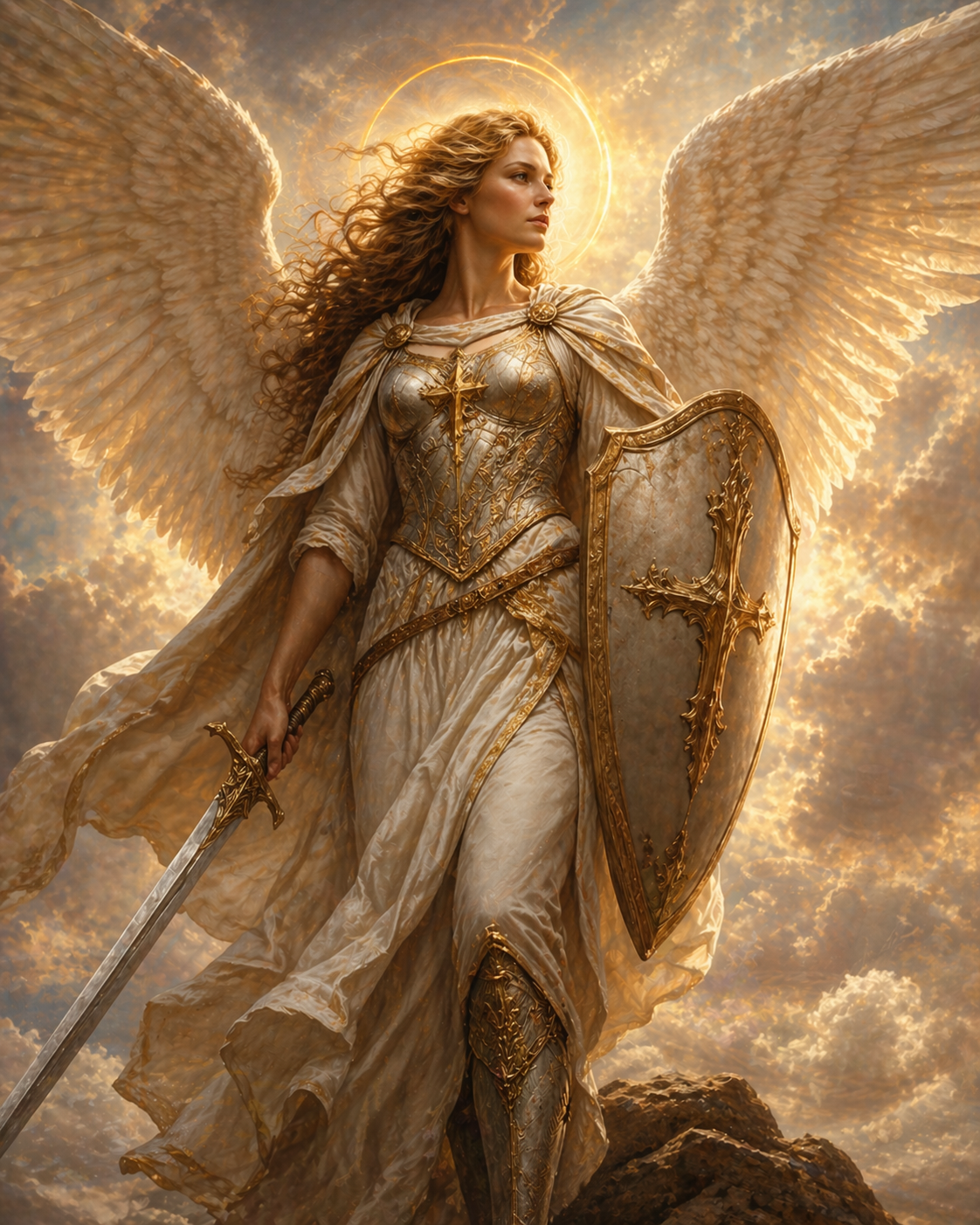
Archangel History: A Snapshot of Belief Systems
by Sister Kate, April 2017
Angels cannot be male or female. As pure spirits, they are each fully realized beings of their own proper nature – this means that each angel is a separate species from the rest. Because angels are completely immaterial and have no bodies, they have no gender.
Nevertheless, they have been given masculine names and the reason for this is clearly the same reason that affects many human habits that slight the feminine – the fact that the first book ever printed for mass distribution was the Bible, a decidedly anti-woman piece of propaganda.
An institution with great influence decided that God is genderless but shall be rendered in paintings and in thought and in word, as a man, and that archangels, likewise, were more ‘man’ than ‘woman’. In Christian art, the archangels are always pictured as men. In the Scriptures, the masculine third person pronoun is used, “he.” In both Hebrew and Greek, the words for “angel” are masculine.
According to Jimmy Atkin, the reasons for making the archangels masculine are:
1) It was the common assumption of many that reason is less vigorous in women than in men. There-fore, as the angels are far more intelligent than men and, as it was thought, men are more intelligent than women, it would be more fitting for an angel to appear as a man than as a woman.
2) While St. Thomas strongly emphasizes that man and woman are both the image of God, as both are rational, he also admits that, in a secondary sense, man is more the image of God than woman – for just as man comes from God and returns to God, so too woman comes from man (having been created from his side) and returns to man (through married life). Tommy the Saint was a misogynist. That means he lived with and wrote from the perspective of contempt for all women. He is credited with introducing to the modern era the idea that men are naturally superior to women. Man is the image and the glory of God, but woman is the glory of man. (Saint Thomas)
3) Angels govern human beings out of love for them and in a well-ordered society, the man is the head of his wife and loves her as Christ loved his Church (Eph 5:25). Thus, on account of their authority and love, angels are depicted as men rather than women. Man is the head of the house and woman is the heart of the house, and who would want to be the head if they could be the heart? (Mary Lou Larscheidt Meeusen 1931-2019)
4) Angels are the messengers of God. In the ancient Hebrew world, only men fulfilled this duty.
5) Angels relate to worship (offering incense, singing hymns, etc.). Worship is a priestly act. This act is expressed in a particular way by the ordained priesthood which, in both the Old and the New Law, is restricted to men. Therefore, angles are depicted as men rather than women.
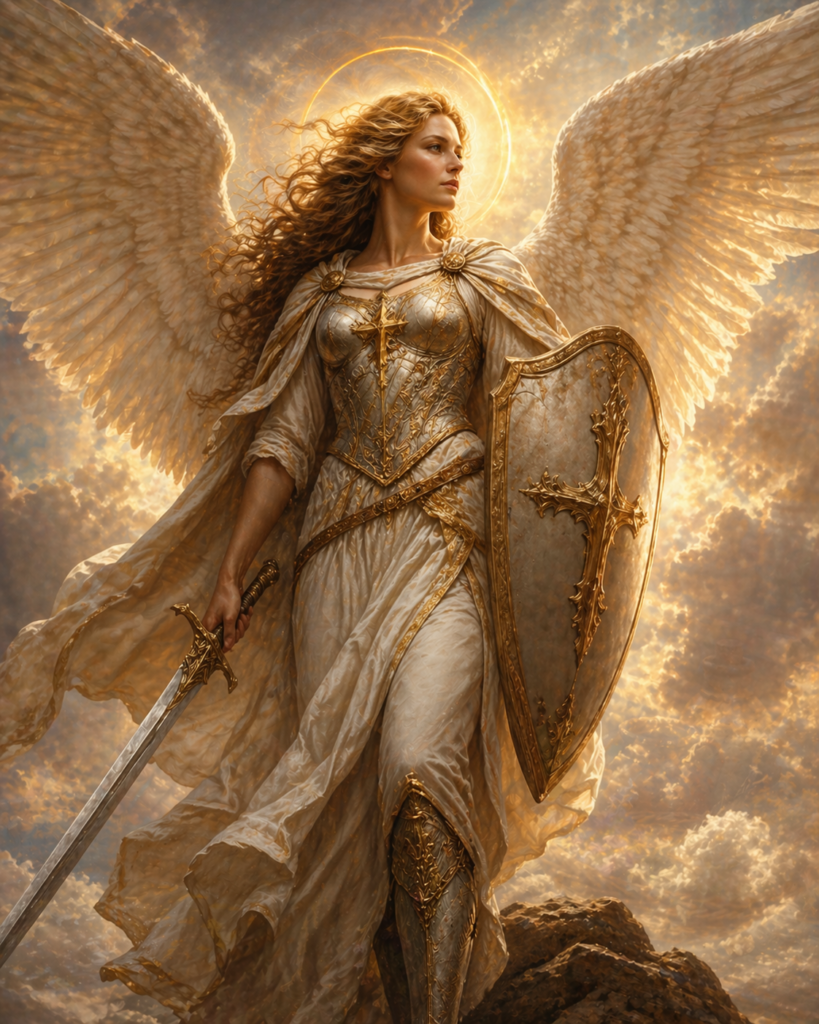
In Summary, there are five basic fallacies that make up the foundation of the idea that archangels are masculine.
- men think ‘better’ than women
- man is more in the image of God than woman is
- man as boss over women is a natural thing
- only men can be angel messengers of God
- men are naturally more priestly, more spiritual, than women
Our Beguine and Native American ancestors believed the opposite. They believed that women, because their cycles are tuned to the moon, because they can Create, like God does, that women, as a birthright, are more spiritual, walk closer to the Creator than men do.
Our ancestors believed in the Spiritual leadership of women and I think they are all in shock that it took us this long to realize that. They are shocked that it took us this long to realize that what is bad for women, is bad for the planet, is bad for our intelligent plants. And that we should have outgrown the anti-feminist principles of Judeo-Christian beliefs a long time ago, and we should have reclaimed our spiritual powers, a long time ago.
Church authorities who had initially supported the Beguines began to view them with growing consternation. Women coming and going unattended at all hours of the day and night, claiming to be on missions of mercy? Women debating theological issues like university scholars? Women translating Holy Scripture? All this, says Swan, led to accusations of sexual misconduct or, worse, heresy.
To mollify church leaders, Beguines found it prudent to make visits in groups or to expand their dwellings to take in patients, the elderly, and school children.
Some Beguines willingly donned distinctive gray dresses and white hoods so as not to be mistaken for prostitutes. Some agreed to live in enclosed communities or to submit to the supervision of a religious house. Sometimes these concessions were not enough. A few Beguines and their works were burned as heretical. It is difficult not to read the accounts of the constraints placed on women Beguines by a suspicious male clerical hierarchy and think of those imposed on women by clerics in many faiths today.
Of course, it’s clear that it would have taken very little for a group of self-supporting women living without benefit of men to fall far enough out of favor to provoke an attack. It is perhaps inevitable they couldn’t be allowed to live in peace, numbers ever growing, in that time and place. Worse though, is how they have been wiped from our cultural memory completely, unable to regrow when better conditions presented themselves.